

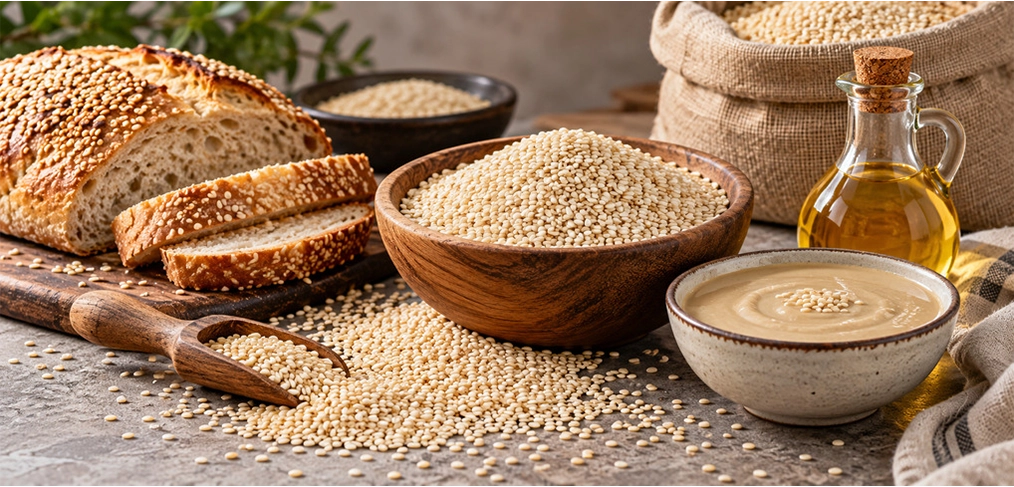
Why sesame is a globally traded seed
Sesame seeds are valued for their nutty flavour, oil content and versatility. They are sold as natural, hulled, roasted, white, black and other market-specific grades. The required form depends on the buyer’s product and processing system.
For exporters, understanding the end user is essential. A bakery may prioritise appearance and seed uniformity, while an oil crusher focuses more heavily on oil yield, cleanliness and processing performance.
Bakeries and commercial food manufacturers
Bakeries use sesame as a topping on bread, burger buns, bagels, crackers and savoury pastries. Food manufacturers also include it in cereal products, seasoning blends and ready-to-eat snacks.
These buyers often need seeds with uniform colour, low foreign matter, controlled moisture and reliable microbiological quality. Hulled white sesame is commonly selected where a clean, light appearance is important.
Tahini and sesame-paste producers
Tahini is made by grinding sesame kernels into a smooth paste. Producers may use hulled seeds for a lighter colour and milder profile, while unhulled sesame can deliver a stronger flavour and different nutritional composition.
Tahini manufacturers focus on taste, colour, oil release, roasting performance, foreign matter and food safety. A consistent seed grade helps keep the finished paste stable from batch to batch.
Edible-oil processors
Sesame contains oil that can be extracted by mechanical pressing, expelling or other controlled methods. Refined and unrefined sesame oils serve cooking, flavouring and ingredient applications.
Oil processors evaluate oil content, seed condition, moisture, contamination and storage history. High moisture, mould, insects or rancidity can reduce yield and compromise the oil.
Confectionery and snack companies
Sesame is used in halva, brittle, bars, coated snacks and seed mixes. Roasting develops aroma and flavour, while the seed’s appearance contributes to the final product.
Buyers need a grade that performs consistently during cleaning, roasting, grinding and forming. Limits for damaged seeds, admixture and off-odours should be written into the purchase specification.
Restaurants and food-service businesses
Restaurants use sesame seeds and tahini in hummus, dressings, sauces, marinades, garnishes and baked products. East Asian, Middle Eastern, Mediterranean and African cuisines use sesame in different forms.
Food-service distributors typically require reliable packaging, allergen information, traceable batches and consistent supply.
Ingredient and spice blenders
Seasoning companies combine sesame with herbs, spices, salt and other seeds. The seed may be used whole, crushed or roasted. Particle size, roast level and flavour must suit the blend.
Because sesame is a major allergen in several markets, processors must maintain appropriate allergen controls and labelling. Importers should confirm the destination’s current legal requirements.
Cosmetic and personal-care manufacturers
Sesame oil is used in some soaps, massage oils, hair products and skin-care formulations. Cosmetic buyers may specify fatty-acid profile, odour, colour, oxidation indicators and refining status.
Food-grade documentation does not automatically satisfy a cosmetic manufacturer’s technical requirements. The intended application should be declared before sourcing.
Natural hulled and black sesame are not interchangeable
Natural sesame retains the outer hull. Hulled sesame has the hull removed and is often selected for tahini, bakery and confectionery applications. Black sesame serves specific culinary, bakery and specialty markets.
The buyer should state seed colour, hulling status, purity, moisture, oil content where relevant, residue requirements, packaging and test methods.
Quality checks for bulk sesame buyers
Visual inspection should be supported by representative sampling and laboratory testing. Depending on the market, tests may cover moisture, purity, foreign matter, microbiological hazards, pesticide residues, mycotoxins, heavy metals and oil characteristics.
Sesame should be stored clean and dry, protected from pests, water and strong odours. Supplier traceability and lot segregation reduce the risk of mixing approved and unapproved material.
Buy Nigerian sesame seeds in bulk
Tinker and Bell Trading supplies Nigerian sesame seeds to international commercial buyers. Importers, processors, bakeries, tahini manufacturers and distributors can submit their required type, specification, packaging, destination and volume.
Visit www.tinkerandbell.com/bulk-orders/ or email sales@tinkerandbell.com to discuss availability.
Frequently asked questions
Who are the main users of sesame seeds?
Bakeries, tahini producers, edible-oil processors, confectionery companies, snack manufacturers, restaurants and ingredient blenders.
What is the difference between hulled and natural sesame?
Natural sesame retains its outer hull, while hulled sesame has the hull removed. The preferred type depends on the final product.
How are sesame seeds used?
They are used whole, roasted, ground into tahini, pressed for oil or blended into bakery, snack, confectionery and seasoning products.
