

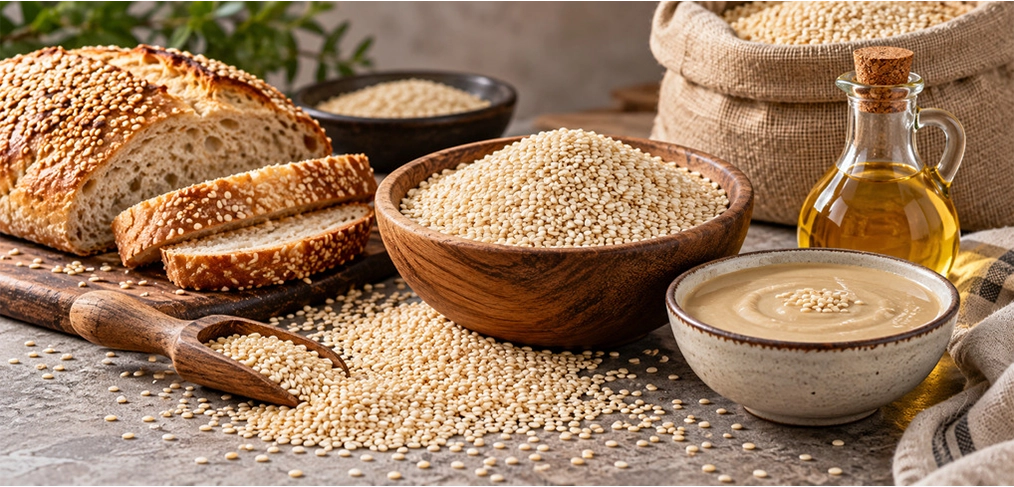
Nigeria is one of Africa’s established producers of sesame seeds, supplying international markets with agricultural raw materials for food manufacturing, cooking oil production, confectionery and other industrial applications.
With favourable growing conditions and established agricultural supply networks, the country offers international buyers opportunities to source quality sesame seeds in commercial quantities.
For importers, wholesalers, food processors and commodity traders, understanding the sesame seeds export from Nigeria process is essential for securing consistent quality, competitive prices and reliable supply.
Types of Sesame Seeds Available in Nigeria
Nigeria produces different varieties of sesame seeds suitable for various commercial and industrial applications.
The major varieties include:
- Natural White Sesame Seeds: Widely used in food production, bakery products, confectionery, sauces and cooking oil manufacturing.
- Hulled Sesame Seeds: Sesame seeds that have undergone a cleaning and hulling process to remove their outer coats. They are commonly used in tahini, bakery products and food processing.
- Black Sesame Seeds: Used in Asian cuisines, confectionery, bakery products and specialty food manufacturing.
Each variety has different applications, processing requirements and market specifications. Buyers should communicate their preferred variety before placing bulk orders.
Major Sesame-Producing Regions in Nigeria
Sesame cultivation is concentrated across several states in Northern and Central Nigeria.
Major producing regions include:
- Nasarawa
- Jigawa
- Benue
- Kano
- Katsina
- Taraba
- Yobe
- Gombe
- Kogi
- Niger
- Plateau
These regions provide access to agricultural communities and established sesame supply networks. Working with experienced sourcing partners helps international buyers coordinate procurement, aggregation and quality control.
Sesame Seed Quality Specifications
Quality is a critical consideration when sourcing sesame seeds for international markets. Buyers should assess the following parameters before approving a shipment:
1. Purity: Sesame seeds should be properly cleaned and graded, with minimal impurities and foreign materials.
2. Moisture Content: Low moisture content is essential for preventing mould development and maintaining product quality during storage and transportation.
3. Oil Content: Oil content is an important consideration for processors purchasing sesame seeds for edible oil production.
4. Foreign Matter: Seeds should be free from excessive stones, dust, sticks, sand and other unwanted materials.
5. Colour and Appearance: Seeds should have a reasonably uniform appearance consistent with the agreed variety and specification.
6. Food Safety: Buyers may require laboratory testing for aflatoxins, pesticide residues, microbiological contamination and other relevant food safety parameters.
Depending on the buyer’s requirements, specifications may include 99% purity, moisture content of 8% maximum and oil content of 45% minimum. Final acceptance should always be based on the agreed contract specifications and independent inspection where required.
Sesame Seeds Export Requirements in Nigeria
Exporting sesame seeds from Nigeria requires compliance with applicable export regulations and destination-market requirements.
Important documentation may include:
- NEPC Exporter’s Certificate.
- Nigeria Export Proceeds (NXP) Form.
- Phytosanitary Certificate from Nigeria Agricultural Quarantine Service (NAQS), where applicable.
- NAFDAC Health Certificate for relevant semi-processed food exports.
- Fumigation and produce inspection certificates, where required.
- Commercial Invoice.
- Packing List.
- Certificate of Origin.
- Bill of Lading.
Buyers and exporters should confirm the specific documentation required for the destination country before shipment.
Packaging and Shipping of Nigerian Sesame Seeds
Proper packaging helps preserve sesame seed quality during storage, handling and international transportation.
Natural and black sesame seeds are commonly packed in clean, export-grade jute or polypropylene bags, typically weighing 45–50kg per bag. Hulled sesame seeds may require specialised food-grade packaging depending on the buyer’s specifications.
For bulk shipments, container loading, moisture protection and proper storage conditions are important considerations.
International shipping arrangements can be negotiated under different Incoterms, including:
- FOB (Free on Board): The seller delivers the goods on board the nominated vessel at the agreed port.
- CFR (Cost and Freight): The seller pays the cost and freight to the destination port.
- CIF (Cost, Insurance and Freight): The seller covers the cost, insurance and freight to the agreed destination port.
Why Source Sesame Seeds from Nigeria?
Nigeria offers international buyers access to established sesame-producing communities, multiple varieties and a developed agricultural export supply chain.
The country’s sesame sector serves different international markets, particularly in Asia and the Middle East. Its production network provides sourcing opportunities for businesses requiring natural white, hulled and black sesame seeds in commercial quantities.
Working with a dependable Nigerian agricultural exporter helps buyers coordinate procurement, quality inspection, packaging, documentation and shipment.
Source Quality Nigerian Sesame Seeds with Tinker and Bell Trading
At Tinker and Bell Trading, we connect international buyers with agricultural commodities sourced from Nigeria.
We understand the importance of product specifications, quality assurance and reliable supply arrangements in international agricultural trade.
Whether you are an importer, wholesaler, food manufacturer, sesame oil processor or bulk commodity distributor, we can discuss your sourcing requirements for Nigerian sesame seeds.
We offer procurement and export coordination for bulk orders, with product specifications and shipment arrangements discussed according to individual buyer requirements.
Looking to buy sesame seeds from Nigeria?
Contact Tinker and Bell Trading to discuss your required variety, quantity, quality specifications and preferred shipping terms.
Website: https://tinkerandbell.com/
Email: sales@tinkerandbell.com
