

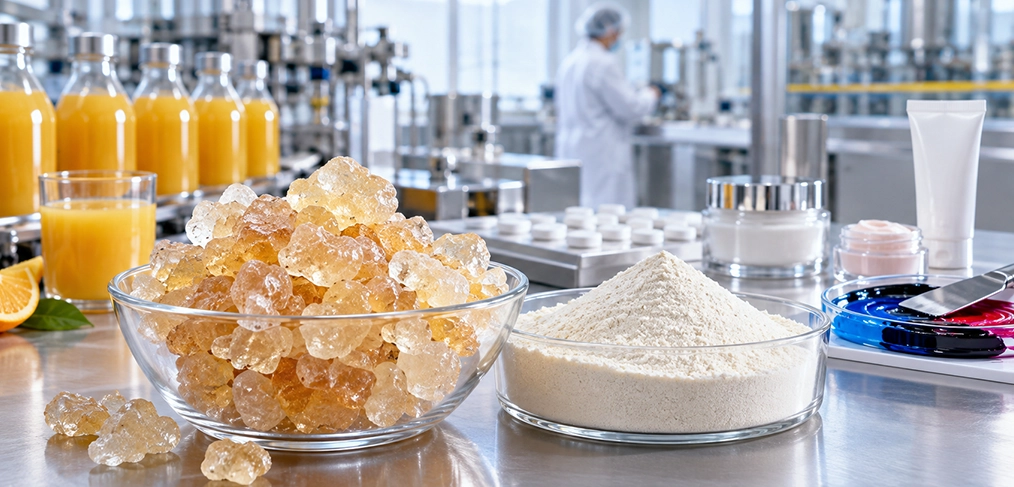
Gum arabic, also called acacia gum, is a natural dried exudate associated mainly with Acacia senegal and Acacia seyal. It is valued because it dissolves in water, forms films, binds ingredients and helps stabilise mixtures containing oil and water.
Those functional properties make gum arabic useful across food, beverage, pharmaceutical, cosmetic and technical manufacturing. However, the correct grade and processing level depend on the application. Buyers should source against a defined functional and purity specification rather than treating all gum arabic as interchangeable.
1. Beverage emulsions
Gum arabic is widely used to help stabilise flavour-oil emulsions in soft drinks and beverage concentrates. It can form a protective layer around oil droplets and reduce separation during storage. This is especially useful when small quantities of flavour oil must remain evenly distributed in a water-based drink.
Beverage manufacturers usually require consistent emulsification performance, low microbial load, suitable colour and odour, and compliance with relevant food-additive rules. Spray-dried, processed gum may be preferred for controlled manufacturing.
2. Confectionery and bakery products
In confectionery, gum arabic can act as a binder, texturiser, glazing agent and film former. It is used in applications such as panned confectionery, coatings, chewy products and lozenges. A thin gum film can add shine and provide a protective surface.
In bakery systems, its role depends on the recipe. Manufacturers should test hydration, viscosity and interaction with sugar, starch, flavours and other hydrocolloids at production scale.
3. Flavour encapsulation and spray drying
Gum arabic is used as a wall material or carrier in the encapsulation of flavours, colours and other sensitive ingredients. During spray drying, it can help trap volatile compounds within a dry powder, improve handling and protect them from environmental exposure.
Performance depends on gum quality, formulation, solids content, homogenisation and drying conditions. Industrial users should specify emulsion stability, particle performance and microbiological requirements.
4. Pharmaceutical formulations
Pharmaceutical manufacturers use suitable grades of gum arabic as a binder, suspending agent, emulsifier, coating component or viscosity modifier. It has also been used in lozenges and tablet-related applications.
Pharmaceutical use demands tighter control than general technical use. Buyers must define the applicable pharmacopoeial or regulatory standard, microbial limits, identity tests, contaminant limits and supplier documentation. Raw gum should not be assumed to be pharmaceutical grade.
5. Cosmetics and personal care
In cosmetics, gum arabic may support film formation, adhesion, suspension, texture and emulsion stability. It can appear in masks, makeup, hair products and other water-based formulations.
Formulators still need compatibility and stability testing. Botanical origin, colour, odour, preservation system, particle size and microbial status can affect the final product. Cosmetic compliance requirements also vary by market.
6. Printing lithography and art materials
Gum arabic has a long history in lithography and printing because it can control water-sensitive surface behaviour and form a workable film. It is also a traditional binder in watercolour paints and related art materials.
Technical buyers may focus on viscosity, filtration, colour and solution cleanliness rather than food parameters alone. Consistency between lots is important because changes can affect flow, adhesion and print performance.
7. Adhesives paper and packaging
Its binding and film-forming properties allow gum arabic to be used in specialised adhesives, paper treatments, envelopes, labels and packaging applications. It may be selected where water solubility or a naturally derived binder is useful.
The manufacturer should test tack, drying time, film strength, humidity response and compatibility with the substrate.
8. Textiles ceramics and other technical uses
Gum arabic can serve as a binder, thickener or temporary processing aid in selected textile, ceramic, pyrotechnic and technical formulations. Its exact role depends on the process and may now compete with synthetic or modified alternatives.
A buyer considering gum arabic as a substitute should compare total formulation performance, not just price per kilogram. Hydration time, dosage, filtration losses and batch consistency can influence the real production cost.
What industrial buyers should specify
A useful purchase specification may cover botanical source, raw or processed form, colour, odour, moisture, ash, insoluble matter, viscosity, microbiological limits, contaminants, particle size, packaging and required certifications. Food and regulated applications may require additional identity, purity and safety criteria.
Request a representative sample and test it in the actual formulation. Laboratory compliance does not automatically guarantee identical performance on every production line.
Sourcing gum arabic from Nigeria
Nigeria is part of the African gum-producing belt and can supply raw and processed material through organised trade channels. A dependable sourcing programme should include origin records, cleaning and grading, lot identification, protective packaging, laboratory verification and controlled storage.
Gum readily picks up contamination and moisture when handled poorly. Finished lots should be protected from rain, dust, pests, strong odours and unsuitable packaging.
Discuss your gum arabic requirement with Tinker and Bell
Tinker and Bell Trading Ltd works with international buyers sourcing Nigerian agricultural commodities. Share the intended industrial use, required grade, test parameters, packaging, destination and volume. This allows the sourcing plan to be matched to your process rather than offering a generic grade.
Visit www.tinkerandbell.com to request a sample discussion or bulk quotation.
Frequently asked questions
Is all gum arabic food grade?
No. Food use requires suitable processing, purity, safety controls and compliance with the applicable food-additive rules.
What is gum arabic used for in beverages?
It commonly helps stabilise flavour-oil emulsions and can support flavour encapsulation.
Should manufacturers test a sample in their formula?
Yes. Functional performance can vary, so application trials are important before a large purchase.
