

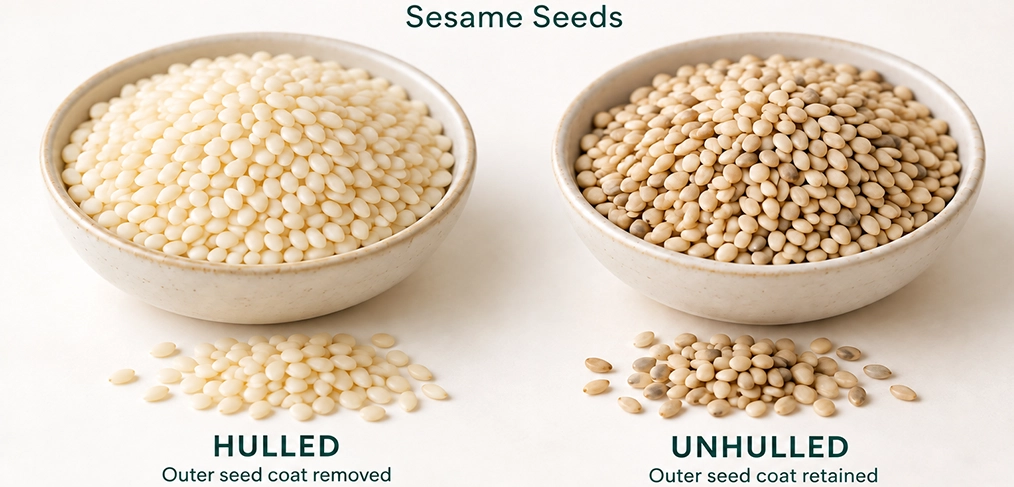
Choosing hulled vs unhulled sesame seeds depends on what your business produces. Both have commercial uses, but the seed coat affects appearance, texture and processing requirements. Start with your finished product specification before comparing supplier quotations.
Understanding hulled vs unhulled sesame seeds
Hulled sesame seeds have their outer seed coat removed. They generally provide a lighter appearance and smoother texture, making them useful for bakery toppings, confectionery and certain sesame pastes.
Unhulled seeds retain the outer coat. They can suit applications where a more pronounced texture or whole seed character is desirable. However, colour alone cannot reliably confirm whether a shipment is hulled. Ask the supplier to identify the product clearly.
Test performance in your recipe
Run production trials before placing a large order. Assess flavour after roasting, appearance in the finished food and how the seeds behave during milling or mixing. For paste production, check whether the sample delivers your required consistency.
Also, compare usable yield. A cheaper shipment can become more expensive if it requires additional cleaning, sorting or processing. Calculate the cost of material ready for your production line.
Agree on quality and origin
Your purchase specification should address purity, moisture, foreign matter, microbiological requirements and packaging. Request relevant test results and batch identification. Confirm country of origin separately for each product offered.
Sesame requires careful allergen management. Consider segregation, cleaning and destination labelling requirements when integrating it into your factory. Neither hulling nor ordinary roasting should be assumed to remove allergen risk.
Retain approved samples for future delivery comparisons.
Discuss your sesame requirements
Tinker & Bell Trading Ltd handles bulk sesame enquiries. Visit our bulk orders page or email sales@tinkerandbell.com with your preferred seed type, specification, quantity and destination. Include your intended application so the sourcing discussion focuses on the characteristics your production process actually needs.
